
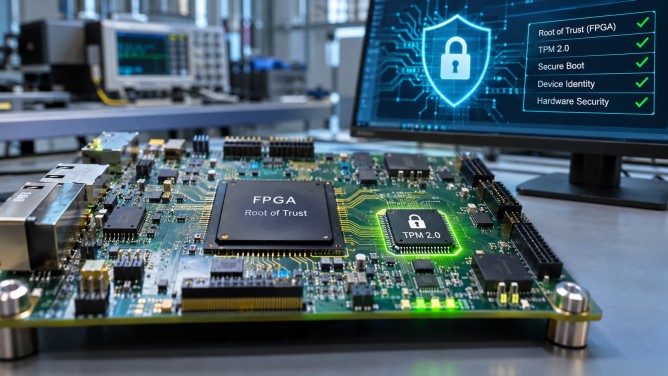
SecEdge, Inc. has launched its SEC-TPM™ firmware-based Trusted Platform Module (TPM) as a TPM 2.0 option for Lattice Semiconductor’s Root of Trust FPGA platforms. This integration allows server designers to leverage TPM 2.0 on the same programmable device tasked with safeguarding, detecting, and recovering platform firmware. The solution is compatible with the Lattice MachXO5™-NX, Lattice Mach™-N2, and Lattice Avant™ FPGA families, aiming to streamline security architectures and reduce hardware needs in hyperscale data centers.
Lattice Root of Trust FPGAs offer hardware-based security features designed to protect platform firmware and ensure secure system operations. These capabilities include NIST SP 800-193 Platform Firmware Resiliency (PFR), CNSA 2.0-aligned post-quantum cryptography, and SPDM-based attestation for Open Compute Project (OCP) architectures. The SEC-TPM extends this security framework by bringing standards-compliant TPM 2.0 functionality to the same device, eliminating the need for a separate discrete TPM chip.
The integration supports various security functions such as measured boot, secure key storage, and host attestation. Sami Nassar, CEO of SecEdge, mentioned that this solution answers the demand from operators seeking standard TPM 2.0 compatibility without adding extra chips to server boards. Mamta Gupta, vice president of Compute and Communications Business at Lattice Semiconductor, emphasized the importance of offering customers more flexibility in platform security design, supporting software interoperability, and reducing potential attack surfaces.
This development could benefit hyperscale data center operators and server manufacturers by simplifying board layouts and reducing bill of materials (BOM) costs. By combining firmware protection and TPM functionality within a single FPGA, the integration may also facilitate faster boot processes and decrease the number of individual security components required. The programmable nature of FPGAs enables platforms to adapt to evolving security needs, which is crucial as data center infrastructure faces increasingly complex cybersecurity challenges.
The availability of SEC-TPM across three Lattice FPGA families provides designers with flexibility in developing secure computing platforms. As demand for trusted hardware architectures grows, the integration of firmware resilience, attestation, and TPM 2.0 functionality within a single device could influence future data center security designs. This advancement represents an additional option for organizations aiming to incorporate standardized security functions into their server infrastructure.
ABOUT SecEdge
SecEdge™ is a pioneer in AI infrastructure security, delivering the trust foundation for the AI era. The SecEdge AI-TRUST™ Platform provides chip-to-cloud AI model protection, provenance, and lifecycle management, enabling organizations to secure and govern AI across devices, edge systems, and cloud environments. Its award-winning technologies establish trust in AI-enabled devices while simplifying compliance with evolving industry and government regulations. As AI becomes critical infrastructure, SecEdge is making trusted AI a reality.
Learn more at www.secedge.com or email [email protected].
Lattice Semiconductor Corporation, Lattice Semiconductor (& design), AMI, and specific product designations are either registered trademarks or trademarks of Lattice Semiconductor Corporation or its subsidiaries in the United States and/or other countries. The use of the word “partner” does not imply a legal partnership between Lattice and any other entity.
Jennifer Walken
SecEdge, Inc.
[email protected]
Legal Disclaimer:
The information contained in this article has been provided by independent third-party contributors, clients, or content partners. We do not independently verify the accuracy, completeness, legality, ownership, licensing, or reliability of submitted content, including text, images, videos, trademarks, or other media materials. The submitting party is solely responsible for ensuring that all content, including images and media assets, complies with applicable copyright, trademark, licensing, and intellectual property laws. We disclaim liability for any unauthorized use of copyrighted or proprietary materials by third parties. If you believe that any content published on this platform infringes your intellectual property rights, kindly contact the author above for prompt review and resolution.