
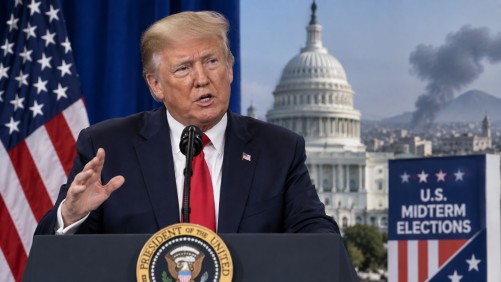
US President Donald Trump has projected that the ongoing conflict between the United States and Iran might conclude after the country’s midterm elections in November. He anticipates a significant drop in oil prices once the hostilities cease. During a conversation with reporters in Dublin, Trump suggested that Iran is striving to extend the conflict to influence the upcoming elections, but he remains hopeful for an end to the war shortly after the midterms.
In response, Iranian President Masoud Pezeshkian emphasized that Iran does not seek war or the continuation of the conflict. Speaking at the BRICS Summit in New Delhi, Pezeshkian reiterated Iran’s commitment to peace and contended that regional security should be ensured by countries within the region, rather than relying on US intervention. His remarks underline Iran’s preference for a diplomatic resolution.
The ongoing conflict has had a significant impact on energy markets, particularly with tensions escalating around the Strait of Hormuz, a critical passage for oil transport. These tensions have contributed to a substantial rise in oil prices, with crude recently surpassing the $100 per barrel mark. The economic repercussions are felt globally, with energy markets closely monitoring the situation.
Despite various attempts to negotiate a settlement, there has been little lasting success in easing the tensions. While the intensity of the fighting has somewhat decreased, the persisting uncertainty continues to pose risks to both regional security and global energy supplies. Stakeholders remain concerned about the potential long-term impacts on these fronts.