
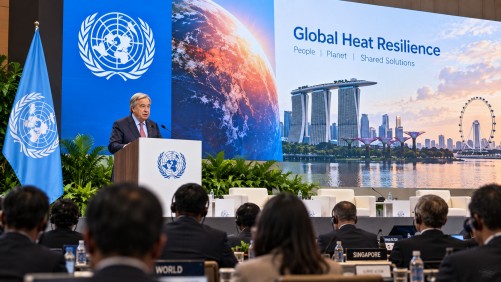
The United Nations has revealed plans to create a Global Heat Resilience Roadmap, aiming to equip nations with strategies to combat the escalating threat of extreme heat. Announced at a forum in Singapore, this initiative seeks to mitigate the risks posed by rising temperatures and safeguard communities worldwide.
During the four-day event, representatives from over 60 countries convened to discuss enhancing heat resilience and curbing emissions linked to cooling systems. The roadmap will target the protection of critical sectors such as water and food supplies, educational institutions, healthcare facilities, workplaces, and energy infrastructures during extreme heat events. Countries will be urged to implement measures like improved building ventilation, increased urban tree cover, shaded public spaces, and energy-efficient cooling solutions.
Addressing the environmental impact of growing air-conditioning demand is a central focus of the plan, as cooling currently accounts for approximately 20% of global electricity consumption, with projections indicating a tripling of demand by 2050. To counter this, the UN emphasizes the need for stronger policies, innovative financing mechanisms, and robust emergency plans.
Singapore, demonstrating proactive measures, has set up a Heat Resilience Policy Office to coordinate its heat-management strategies. The country plans to establish over 300 cooling centers during heatwaves and has introduced energy-efficiency standards for air-conditioners, which have significantly improved cooling efficiency.
The roadmap is expected to build upon existing national heat resilience strategies, with participating countries having several years to formulate and implement tailored measures. Additionally, the initiative will include systems to monitor progress and evaluate the effectiveness of national actions, ensuring that countries remain accountable and adaptive to emerging heat challenges.