
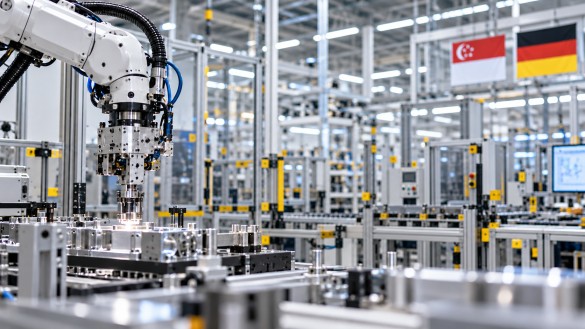
Singapore and Germany have committed to enhancing their collaboration in the fields of artificial intelligence (AI) and industrial technology, following a meeting between Singapore Prime Minister Lawrence Wong and German Chancellor Friedrich Merz on October 27. This agreement updates their strategic partnership roadmap, initially introduced in 2024, by focusing on industrial AI, the digital economy, advanced manufacturing, and emerging technologies.
The leaders stressed the transformative potential of AI in various sectors, emphasizing its capability to boost productivity and open new avenues for businesses and workers. The partnership aims to expand the application of industrial AI in manufacturing, robotics, logistics, and other physical operations. They also plan to fortify cooperation on AI safety and security, ensuring responsible deployment and maintaining a human-centric approach.
Research collaboration will see a boost during the Singapore-Germany Year of Innovation, with joint projects expected in areas such as AI, semiconductors, quantum technology, space, green technologies, and advanced manufacturing. This initiative builds on existing academic and research partnerships, intending to accelerate innovation and technological progress.
In addition to technological cooperation, Singapore and Germany aim to strengthen economic ties between the Association of Southeast Asian Nations (ASEAN) and the European Union (EU). Singapore plans to collaborate with Germany during its 2027 ASEAN chairmanship to promote regional cooperation, including efforts towards an ASEAN-EU free trade agreement and enhanced integration of digital systems.
Discussions between the leaders also touched on regional energy connectivity and safeguarding critical underwater infrastructure, such as subsea cables and pipelines. Germany’s support for Singapore’s voluntary initiative on underwater infrastructure protection underscores a shared commitment to international law, multilateral cooperation, and a rules-based international order.